Old Gods
Updated: Feb 16

This series is an exploration of familial relationships and the uncertainty that comes with perceived knowledge of an individual based on our own limited interactions, within a different, specific stage of each person’s life. It is a reflection of the clarity I find when viewing past moments of a loved one through my own experiences and understanding that there are some I can’t relate to yet and some I never will. Trying to view older family members as my own age helps exponentially, especially if I consider when and where they were my age. This of course comes with the consequence of them aging first. This series began by sorting through family photos from the 1930s to 2023. Isolating the images that stirred the most emotional response and intrigue, I then chose the most dynamic pieces of each. Compositions were put together like puzzle pieces, rearranging until I found something that fit. After settling on a concept and first compositional sketch, which would become the piece Mothers, I created my layout. Using a scaled down physical sketch and measurements based on resources and a desire to work large, the structure emerged. Sketches were then plugged in and edited as needed.

My interest in narrative painting, and painting in general, was first sparked by 17th Century Italian Renaissance/ Baroque painter, Artemisia Gentileschi. Her work Aurora, 1625-1627 is one piece that showcases her mastery in the world of painting. The diverse, engaging composition coupled with a unified color palette are aspects I look to emulate in my work. Amanda Ba is a contemporary artist whose work, especially in terms of color, figuration and narrative, piques my interest and guides my choices. More importantly, both of these artists also use their work as a repossession of personal narratives. Gentileschi explored concepts in her work that she wasn’t able to address in her daily life, Ba uses her work to give an honest look into her mind. Seeing how two very different artists explored this idea of narrative painting was inspiring, as was the vulnerability that comes with exposure to an audience other than myself.
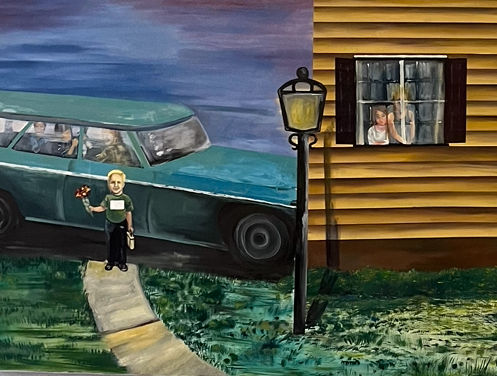
My grandparents moved out of their home I grew up visiting right before my last year of college. I overheard my grandma telling my mom that she needed to drop all their curtains at the dumpster, and then the house would be ready for its new owners. Not knowing what I would use them for, I asked if I could take them instead. The curtains arrived in two big black trash bags and smelled like home. These became the canvas for five of the nine paintings in this series. Back By Dark is one such painting and the curtain became an important factor in the composition. When it was stretched, I was attracted to the sun bleached areas and the thinness of the material which resulted in leaving part of the curtain raw, not gessoed or painted.

I have been very interested lately in how the first few washes of paint look on the canvas and in this case my fabric, the sun, and time had already created it for me. Mamma Andersson’s piece Swannery (2019) is one that uses thin washes as a grounding factor of the composition. Andersson is a newer influence for me but her techniques and ideologies are intriguing. “Her often-panoramic scenes draw inspiration from a wide range of archival photographic source materials, filmic imagery, theater sets, and period interiors, as well as the sparse topography of northern Sweden, where she grew up: mountainous backdrops, trees, snow, and wooden cabins are recurrent elements within her works. Yet, rather than conveying specific spatial or temporal reference points, they revolve around the expression of atmospheres and subjective moods, and frequently appear to merge the past, the present, and the future.” Reading her artist’s statement and looking at the work helped me to clarify my own thoughts about my intentions. Focusing on the merging of past, present, and future is the basis of my work, especially in this series about family. I am taking my family’s past into the present and future.
My piece 322 Circle Way represents my sudden feelings of collision between childhood and adulthood, and the confusion and inability to understand what was going on around me. It shows the chaos that accompanies five adolescents at different stages, each determined to follow their own path and desires. It is reflective of how we would play as kids, the imaginary worlds and characters that we would create and exist as in that reality. My current adult self is also in this piece, the only one who doesn’t seem to understand their surroundings. I am behind my oldest sister, both crossing giant lily pads, inspired by the ones found in the kid's area of the Baltimore Zoo. She was the one who always wanted to help the rest of us cross, once we were too old to be carried across by our mom. My sister is looking down to the next steps ahead, seemingly unaware that I am not holding her outstretched hand or the same version of myself that originally needed help crossing. A small safety gate separates the lily pads from the kitchen floor, where my three other siblings and much younger self are scattered about.

This series relates directly to specific people in my life, in this instance the family members that I grew up around. It is an effort at communicating more clearly and understanding them in a new way. Using references and images that I know my family will understand creates a common ground that brings them into my world. However, this difference in interpretation is not a hindrance. Instead it allows for my work to exist as a personal memento and creates the opportunity for anyone to find what they might be looking for. The series of paintings also gives a clearer image of how I view and process things. Processing emotions in real time was difficult for me growing up. Having nine interconnected but separate pieces creates more opportunities for movement, change, and isolated existence which reflects areas I had struggles with. The multiple versions of the same person and the unrealistic or imagined spaces are reflective of my difficulty in understanding and processing situations that seemed simple to those around me. These different parts allow each piece to represent different areas of my family's lives. Together they form a more complete representation of family, one that needs multiple parts to be told and understood.
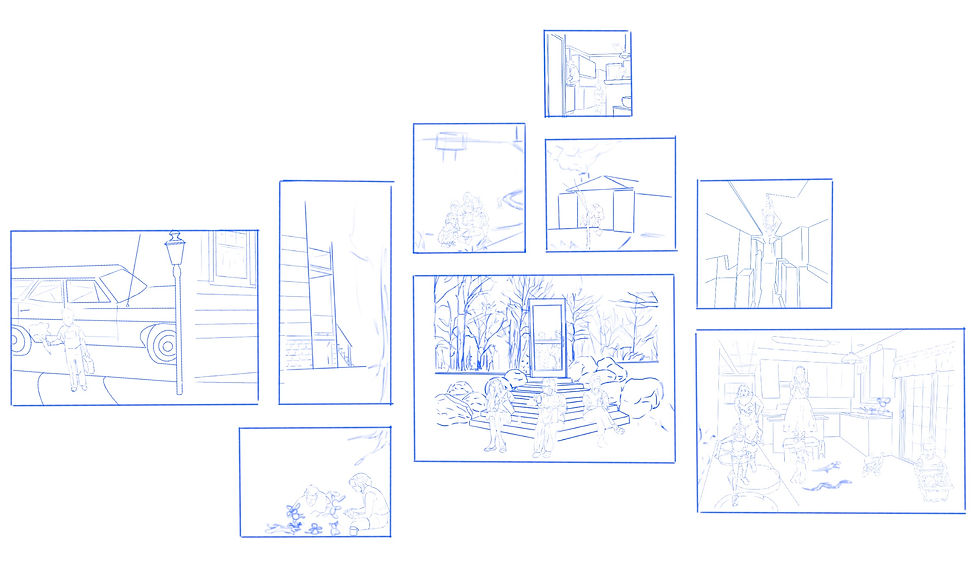
As stated earlier, my main motivation for creating work is the desire to work through my emotions and thoughts in order to fully process them. In this exploration of family, childhood, and how relationships are formed because of those factors, that desire remains. It is to understand myself, my family, and my childhood although I wasn’t as clear about this when I started. I commonly don’t know what I want my work to be; more accurately I don’t know how to articulate my thoughts on what I want it to be. Being able to represent myself in words has always been difficult, especially when I couldn’t fully understand what I was actually feeling. Painting has been important in developing my skills of communication and my ability to understand my emotions. Creating narrative based work allows me to sit with experiences for an extended time and examine them more thoroughly. In this case I was revisiting and researching memories of childhood that hadn’t been explored in a while. Each piece is a memory of family and represents different aspects of our story. Even though this iteration of it is being told by me, I am not the focus, my concentration being the examination of familial relationships, beginning in adolescence and looking for the root of behaviors. Being able to re-experience these frozen moments in time and the resulting sparking of more memories was enlightening. It was difficult to remember how often emotions and perceived realities clouded my judgement but doing so allowed me to more accurately represent myself. I am not interested in creating a character, I want to convey a story. In this instance, it is a story reflecting the distortion of reality that accompanies adolescence and the influence that living with others during this time has on adult relationships.
This began as a curiosity to revisit childhood photos and took on a life of its own. I found myself with a collection of memories and a need to make them all make sense. My research still involved artists and historical references but it started with my family. As I worked the series shifted and evolved, which I like my work to be able to do. Creating compositional sketches gave me the bones I needed to build my body of work, providing enough structure to look for freedom in the painting. Using the influence of artists like Artemisia Gentileschi, Amanda Ba, and Mamma Andersson to support my decision making process was important because it was able to give me more support and confidence in areas I am less familiar with. It allowed me to experiment with my materials, like using curtains as canvas and was encouraging in trying new ways of painting. My mark making and use of washes are more varied and successful, due in part to the size of the project. Having a larger series allowed me to work on multiple ideas, concepts, and techniques at the same time. I could explore so many different opportunities, while relying on the skeleton I created to hold it all together.




Bibliography
“Amanda Ba: Art-Discontent.” Art, art-discontent.com/art/amanda-ba/. Accessed 4 Apr. 2024.
Andersson, Mamma. Swannery. 2019.
“Artemisia Gentileschi.” Brooklyn Museum,
www.brooklynmuseum.org/eascfa/dinner_party/place_settings/artemisia_gentileschi. Accessed 4 Apr. 2024.
Ba, Amanda. Real-Tree. 2023.
Gentileschi, Artemisia. Aurora. 1625, Rome.
“Info.” Amanda Ba 把蔓沁, amandaba.com/Info. Accessed 4 Apr. 2024.
“Mamma Andersson - Artworks & Biography.” David Zwirner,
www.davidzwirner.com/artists/mamma-andersson. Accessed 4 Apr. 2024.


Comments